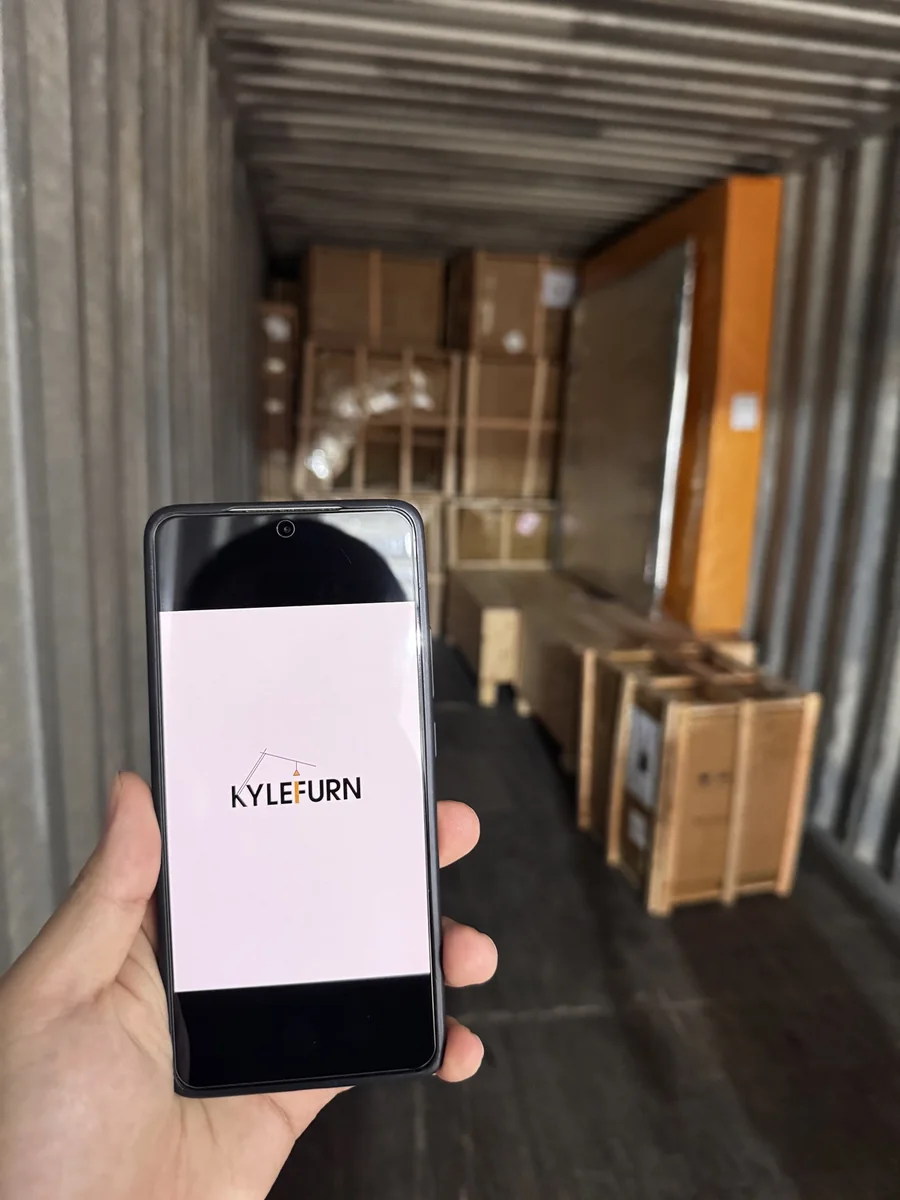
Can you buy furniture from multiple suppliers in China and ship everything together? Yes. In fact, this is very common for whole-house furniture projects.
If you are furnishing a villa, apartment, hotel, office, or other large project, it is unlikely that one factory will produce everything you need.
You may buy:
- Sofas from one factory
- Beds from another
- Dining tables from a third supplier
- Mattresses from a specialist manufacturer
- Lighting from another supplier
- Outdoor furniture from a different factory
- Curtains, rugs, mirrors, and accessories from several more suppliers
Instead of shipping every order separately, these products can usually be collected, inspected, consolidated, and loaded together for international shipping.
This process is called furniture consolidation.
For overseas buyers who buy furniture from multiple suppliers in China, consolidation makes it possible to organize products from different factories into one shipment.
But it requires good coordination.
Here is how the process normally works.
1. Why Buy Furniture from Multiple Suppliers in China?
China has a very large furniture manufacturing industry, but different factories usually specialize in different products.
A factory that makes excellent sofas may not produce high-quality beds.
A mattress manufacturer normally does not produce dining tables.
A lighting supplier will usually be completely separate from a furniture factory.
This means that when furnishing an entire property, using several suppliers can actually be an advantage.If this is your first time sourcing from China, our complete guide to buying furniture from China explains the entire process from supplier selection to inspection, consolidation and shipping.
It allows you to choose the strongest supplier for each product category rather than buying everything from one company simply for convenience.
For example, a whole-house project may include:
- Living room furniture
- Bedroom furniture
- Dining furniture
- Mattresses
- Outdoor furniture
- Lighting
- Rugs
- Curtains
- Mirrors
- Decorative accessories
These products may come from 5, 10, 15, or even more suppliers.
The challenge is not buying them.
The challenge is getting everything ready at the right time and shipping it together.
2. How Does Furniture Consolidation Work?
A typical multi-supplier furniture project follows a process like this:
Supplier selection
↓
Order confirmation
↓
Production
↓
Quality inspection
↓
Delivery to consolidation warehouse
↓
Quantity and packaging check
↓
Container planning
↓
Container loading
↓
International shipping
Instead of asking every supplier to ship internationally on its own, each supplier sends the finished goods to one designated warehouse or loading location in China.
The products are then organized and prepared for one combined shipment.
This creates a much more manageable shipping process.
3. Do All Suppliers Need to Finish Production at the Same Time?
Not exactly.
This is one of the main reasons a consolidation warehouse is useful.
Different suppliers will have different production schedules.
For example:
- Sofa factory: 35 days
- Dining furniture factory: 25 days
- Bed factory: 30 days
- Lighting supplier: 20 days
- Outdoor furniture factory: 40 days
The first supplier may finish several weeks before the last one.
Instead of immediately shipping each order separately, the completed products can be delivered to a consolidation warehouse and stored while the remaining suppliers finish production.
Once the main orders are ready, the shipment can be organized together.
However, timing needs to be managed carefully.
If one supplier is significantly delayed, it can affect the entire shipping schedule.
4. Why Is Production Coordination Important?
With one supplier, you only need to follow one production schedule.
With ten suppliers, you may have ten different production schedules.
You need to know:
- When production starts
- Expected completion date
- Whether materials have arrived
- Whether production is delayed
- When inspection can be arranged
- When the goods can leave the factory
- When they will arrive at the warehouse
This is especially important if you have already planned a container booking.
A delay from one important supplier could result in:
- Rescheduling the container
- Additional warehouse storage
- Leaving some products behind
- Sending a second shipment later
Good project coordination helps reduce these problems.
5. Should Furniture Be Inspected Before Going to the Warehouse?
Whenever practical, yes.
It is usually better to identify problems while the furniture is still at the supplier’s factory.
Common furniture issues include:
- Wrong dimensions
- Incorrect fabric
- Wrong color
- Scratches
- Damaged corners
- Poor stitching
- Missing parts
- Incorrect hardware
- Uneven finishing
- Incorrect quantities
- Packaging problems
If an issue is found at the factory, the supplier can usually repair or replace the product more easily.
Once everything has already been packed and transported to another warehouse, correcting problems becomes more complicated.
For a detailed inspection process, see our furniture quality inspection checklist before shipping.
For this reason, inspection and consolidation should be treated as two different stages.
Inspection checks the product.
Consolidation organizes the shipment.
6. What Happens When Furniture Arrives at the Consolidation Warehouse?
When products arrive at the warehouse, they should be checked against the project records.
Depending on the project, this may include confirming:
- Supplier name
- Product quantity
- Number of packages
- Packaging condition
- Shipping marks
- Product labels
- Carton or wooden crate condition
- Approximate CBM
- Missing packages
For large projects, keeping accurate records is very important.
Imagine receiving goods from 12 different suppliers over several weeks.
Without a clear tracking system, it is easy to lose track of which products have arrived and which are still missing.
7. What Is CBM and Why Does It Matter?
CBM means cubic meter.
Furniture shipping is heavily affected by volume because furniture is often large relative to its weight.
For example, sofas, dining chairs, mattresses, and beds may occupy a lot of space even if they are not extremely heavy.
Each supplier can provide an estimated packing volume, but the final shipping volume may change after production and packaging.
This matters because container space is limited.
Common container options include:
- 20-foot container
- 40-foot container
- 40-foot High Cube container
For smaller orders, LCL shipping may also be possible.You can learn more about container sizes, LCL, FCL, CBM and related costs in our furniture shipping costs from China guide.
Before loading, the total volume should be estimated carefully so that the correct shipping method can be selected.
8. Can Furniture From Different Factories Go Into the Same Container?
Yes.
This is one of the main purposes of consolidation.
Furniture from different suppliers can normally be loaded into the same container as long as the products and export arrangements are properly coordinated.
For example, one container could contain:
- 2 sofas from Supplier A
- 4 beds from Supplier B
- 12 dining chairs from Supplier C
- 2 dining tables from Supplier D
- Mattresses from Supplier E
- Lights from Supplier F
- Rugs and decorations from Supplier G
To the buyer, it becomes one combined shipment instead of seven separate international shipments.
This can significantly simplify the project.
9. How Is the Container Loaded?
Container loading is more important than many first-time buyers realize.
Furniture varies greatly in:
- Size
- Weight
- Shape
- Fragility
- Packaging strength
Heavy products should not be placed where they can damage more fragile furniture.
Glass, marble, mirrors, lighting, and delicate finishes may require extra protection.
The loading team also needs to use the container space efficiently.
Poor loading can lead to:
- Wasted space
- Damaged cartons
- Crushed furniture
- Movement during transportation
- Difficulty unloading at destination
For larger furniture projects, loading supervision can therefore be an important part of quality control.
10. What If One Supplier Is Late?
This happens occasionally in real-world projects.
There are usually several possible options.
Option 1: Wait for the Supplier
If the delayed products are important and the delay is relatively short, the project may wait before loading the container.
Option 2: Ship Without the Delayed Products
If most of the project is ready, the main shipment can sometimes leave first, with the remaining products shipped later.
Option 3: Adjust the Shipping Plan
Depending on volume, destination, and timing, the remaining goods may later be sent by LCL or combined with another shipment.
There is no single solution that works for every project.
The decision depends on timing, volume, shipping cost, and how urgently the products are needed.
11. Is Consolidating Furniture Cheaper Than Shipping Separately?
It can be.
Shipping separately from many suppliers often creates duplicated costs.
Each individual shipment may involve:
- Pickup charges
- Export handling
- Documentation
- Customs-related processing
- Freight charges
- Destination handling
- Local delivery
Combining goods into one larger shipment can reduce some duplicated logistics costs.
However, consolidation itself may also involve costs such as:
- Domestic transportation
- Warehouse handling
- Storage
- Loading
- Additional packaging
The best option depends on the size of the project.
For a full-house furniture purchase, consolidation is often much more practical than arranging international shipping separately with every supplier.
12. What About Furniture From Foshan, Guangzhou, and Other Cities?
Furniture does not necessarily have to come from one city.
For example, a project may include products from:
- Foshan
- Guangzhou
- Dongguan
- Shenzhen
- Zhongshan
- Other manufacturing areas in China
These products can still potentially be consolidated into one shipment.
However, longer domestic distances create additional transportation costs and require more coordination.
For buyers sourcing primarily from Foshan and the surrounding Pearl River Delta manufacturing region, consolidation is generally easier because many suppliers are located relatively close to each other.
13. Can Lighting, Sanitary Ware, and Building Materials Be Shipped With Furniture?
In many projects, buyers purchase more than furniture.
They may also source:
- Lighting
- Mirrors
- Rugs
- Curtains
- Decorative items
- Bathroom products
- Doors
- Cabinets
- Some building materials
Some of these products may be able to travel in the same shipment.
However, compatibility depends on factors such as:
- Product type
- Packaging
- Weight
- Fragility
- Customs requirements
- Destination-country regulations
Heavy building materials, for example, may require different loading considerations from sofas and upholstered furniture.
For mixed-product shipments, planning becomes especially important.
14. What Documents Are Needed?
The exact documentation depends on the shipment and destination country.
Common international shipping documents may include:
- Commercial invoice
- Packing list
- Bill of lading
- Export-related documents
- Customs documentation
Some countries or product categories may require additional documents.
Import regulations, duties, taxes, and customs procedures vary by destination, so these should be checked for the specific country before shipment.
15. What Are the Biggest Risks When Buying From Multiple Suppliers?
Multi-supplier sourcing gives buyers more choice, but it also increases project complexity.
The main risks include:
Production Delays
One late factory can affect the shipping schedule.
Inconsistent Quality
Different factories may have different production standards.
Missing Products
With hundreds of items and packages, accurate order tracking is important.
Packaging Problems
Not every factory uses the same export packaging standard.
Wrong Specifications
Color, size, material, or product details may differ from what was ordered.
Poor Communication
Information can become confusing when many suppliers are communicating separately.
Container Space Problems
Estimated CBM may differ from the final packed volume.
These problems are manageable, but they require organization.
16. Why Do Overseas Buyers Use a Furniture Sourcing Agent for Consolidation?
The difficult part of a whole-house furniture project is often not finding furniture.
It is coordinating everything after the products have been selected.
Someone needs to keep track of:
- Different suppliers
- Different orders
- Production schedules
- Product specifications
- Inspection results
- Factory delivery dates
- Warehouse arrivals
- Packaging
- Total volume
- Container planning
- Shipping
For an overseas buyer, managing all of this remotely can take a significant amount of time.
When you buy furniture from multiple suppliers in China, keeping track of production, inspection and delivery dates becomes especially important.
A local furniture sourcing agent can act as the coordination point between the buyer, suppliers, warehouse, inspection team, and shipping partners.Learn more about the services a Foshan furniture sourcing agent can provide throughout a multi-supplier project.
17. How KYLEFURN Manages Multi-Supplier Furniture Projects
KYLEFURN helps overseas buyers source and coordinate furniture from multiple suppliers in Foshan and surrounding manufacturing areas.
Depending on the project, the process can include:
1. Product and supplier sourcing
We help identify suitable products and suppliers according to the buyer’s style, quality requirements, and budget.
2. Order organization
Product information, quantities, specifications, and supplier details are organized for easier project management.
3. Production follow-up
We communicate with suppliers and track production progress.
4. Quality inspection
Furniture can be checked before shipment so that problems can be identified before the goods leave China.
5. Supplier delivery coordination
Different suppliers are coordinated so their products can be delivered to the consolidation location.
6. Consolidation
Goods from multiple suppliers are organized and prepared for combined shipping.
7. Container loading
Products are checked and arranged for container loading.
8. Shipping coordination
The shipment can then be prepared for delivery to the buyer’s destination.
The exact process depends on the size, destination, and requirements of each project.
18. Example: Furnishing a Villa From Multiple Suppliers
Imagine an overseas buyer furnishing a four-bedroom villa.
The project includes:
Supplier A: Living room sofas and chairs
Supplier B: Dining table and chairs
Supplier C: Four bedroom sets
Supplier D: Mattresses
Supplier E: Outdoor furniture
Supplier F: Lighting
Supplier G: Rugs and accessories
Instead of organizing seven separate international shipments, the products can be produced by the individual suppliers and then brought together.
Each supplier completes production.
↓
Products are inspected.
↓
Goods are delivered to the consolidation warehouse.
↓
Packages and quantities are checked.
↓
Total shipping volume is confirmed.
↓
Everything is loaded into the appropriate container.
↓
The container is shipped to the destination country.
This is why multi-supplier furniture sourcing can work very well for whole-house projects when the process is properly managed.
Frequently Asked Questions
Can I buy furniture from 10 different factories in China?
Yes. Whole-house projects commonly involve multiple suppliers. The important part is coordinating production, inspection, delivery, consolidation, and shipping.
Can all my furniture go into one container?
Often yes, provided the total volume fits the container and the products can be safely loaded together.
What if my suppliers finish production on different dates?
Completed products can usually be delivered to a consolidation warehouse while the remaining suppliers finish production.
Should I inspect the furniture before consolidation?
Whenever possible, inspection should take place before the goods leave the supplier so that any problems can be corrected more easily.
Can I combine small orders from different suppliers?
Yes. Whether FCL or LCL shipping makes more sense will depend on the total volume and destination.
Do all the suppliers need to be in Foshan?
No. Products from different cities can potentially be consolidated, although additional domestic transportation and coordination may be required.
Final Thoughts
Yes, you can buy furniture from multiple suppliers in China and ship it together.
For many whole-house projects, this is actually the most practical way to buy furniture.
It allows you to select the right supplier for each category rather than depending on a single factory for everything.
The key is coordination.
A successful multi-supplier furniture project requires:
Supplier coordination → production follow-up → inspection → warehouse consolidation → container planning → loading → shipping
When these stages are managed properly, even a project involving many different suppliers can be organized into one streamlined shipment.
If you are planning to furnish a villa, apartment, hotel, or other project from China, KYLEFURN can help coordinate suppliers, inspections, consolidation, container loading, and shipping from Foshan.
Contact KYLEFURN to discuss your furniture sourcing project in China.