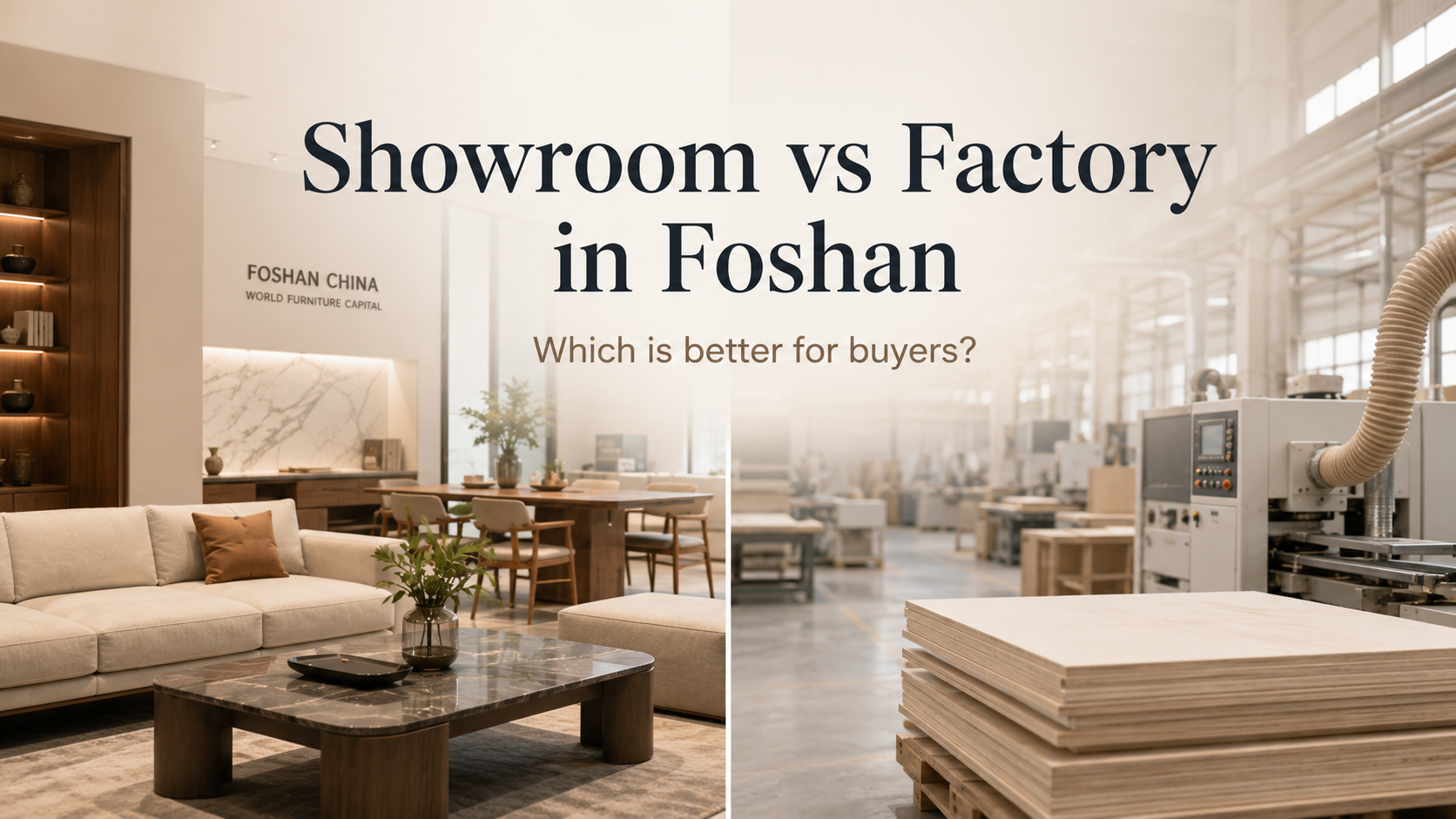
When sourcing furniture in China, many buyers are unsure whether they should visit a furniture showroom or go directly to a factory.
The choice between a furniture showroom vs factory in Foshan depends on your order quantity, product requirements, budget, and whether you need standard or customized furniture.
Showrooms are often more efficient for buyers purchasing many product categories, while factories may be more suitable for larger quantities and customized production. Understanding the difference can help you plan a more efficient sourcing trip.
Furniture Showroom vs Factory in Foshan: Key Differences
A furniture showroom displays finished products that buyers can view, test, and compare directly.
Some showrooms are operated by factories, while others represent several manufacturers. Large furniture markets in Foshan contain thousands of showrooms offering sofas, dining furniture, beds, cabinets, outdoor furniture, lighting, and home decoration.
Showrooms are especially useful for buyers who want to compare different styles and suppliers in a short time.
Advantages of Buying from Showrooms
Furniture showrooms offer several advantages:
- Many products are displayed in one location
- Buyers can compare styles, materials, and prices quickly
- Small quantities may be accepted
- Different furniture categories can be purchased together
- Finished samples can be inspected immediately
- Product selection is faster than visiting multiple factories
For residential projects, apartments, villas, and small retail orders, showrooms are often the most efficient option.
A buyer furnishing an entire house may need sofas, dining tables, beds, chairs, lighting, and decorative products. Visiting individual factories for every category would take much more time.
A professional Foshan furniture market tour can help buyers identify suitable showrooms based on their style, quality level, and budget.
Possible Limitations of Showrooms
Showrooms may also have some limitations:
- The showroom may not own the factory
- Product customization may be limited
- Production details may not be immediately available
- Prices may include showroom operating costs
- The displayed sample may differ from mass production
Before ordering, buyers should confirm who manufactures the product, where the factory is located, and whether the specifications can be recorded in writing.
What Is a Furniture Factory in Foshan?
A furniture factory is responsible for manufacturing products. Depending on the product category, the factory may handle woodworking, metalwork, upholstery, painting, assembly, and packaging.
Factories usually specialize in a limited range of products. For example, one factory may produce only sofas, while another focuses on dining chairs or wooden cabinets.
Advantages of Buying Directly from Factories
Buying directly from a factory may provide:
- Better control over product specifications
- More customization options
- Clearer production information
- Easier access to materials and construction details
- More competitive pricing for larger quantities
- Better conditions for long-term cooperation
Factories are generally more suitable for wholesalers, retailers, developers, hotel projects, and buyers ordering repeated products in larger quantities.
Factory visits also allow buyers to inspect:
- Production equipment
- Raw materials
- Workshop conditions
- Production capacity
- Quality-control procedures
- Packaging methods
For customized products, visiting the factory can help both sides confirm dimensions, materials, finishes, hardware, and production requirements.
Possible Limitations of Factories
Factories are not always the best choice for every buyer.
Common limitations include:
- Higher minimum order quantities
- Fewer product styles in one location
- Longer travel time between factories
- Limited ability to supply different furniture categories
- Less flexibility for small mixed orders
- Some factories do not have professional export staff
A factory may offer a good price for 100 identical dining chairs but may not accept an order for only four chairs.
Is a Factory Always Cheaper Than a Showroom?
Not necessarily.
Many buyers assume that buying directly from a factory always guarantees the lowest price. In reality, the price depends on quantity, specifications, materials, packaging, and the supplier’s business model.
A factory may offer a lower unit price for a large order, but a showroom may provide better value for small quantities because it can combine products from different suppliers.
Some showrooms are directly operated by factories, meaning the displayed price may already be close to the factory price.
Buyers should compare complete specifications instead of comparing only the final price. Two similar-looking sofas may use different frames, foam densities, fabrics, springs, and packaging standards.
The cheapest quotation is not always the most cost-effective option.
Which Option Is Better for Residential Buyers?
For private homes, apartments, and villas, showrooms are usually more convenient.
Residential buyers often need:
- Different furniture categories
- Small quantities per model
- Coordinated styles and colors
- Products from several suppliers
- Consolidation into one shipment
A showroom allows buyers to select many products during the same trip. The orders can later be collected from different suppliers and consolidated before shipping.
However, a factory visit may still be useful when the project includes customized sofas, cabinets, beds, or other specially designed products.
Which Option Is Better for Commercial Buyers?
Factories are often more suitable for:
- Furniture retailers
- Wholesalers
- Hotels
- Restaurants
- Property developers
- Interior design projects
- Private-label furniture brands
Commercial buyers usually require larger quantities, consistent specifications, repeat production, and customized packaging.
For these orders, direct factory communication provides better control over production and quality standards.
A Foshan furniture sourcing agent can help screen factories, compare quotations, confirm specifications, follow production, and arrange inspections.
Can Buyers Use Both Showrooms and Factories?
Yes. In many cases, using both is the best approach.
Buyers can first visit showrooms to understand available styles, materials, and price levels. After identifying suitable products, they can decide whether a factory visit is necessary.
A typical sourcing process may include:
- Visiting furniture markets to compare products
- Selecting suitable models and suppliers
- Visiting factories for larger or customized orders
- Confirming specifications and quotations
- Following production and inspecting finished products
- Consolidating products before shipment
This combined approach provides the convenience of showroom selection and the production control of factory sourcing.
Questions to Ask Before Placing an Order
Whether purchasing from a showroom or factory, buyers should ask:
- Who manufactures the product?
- Can the factory be visited?
- What materials are used?
- What is the minimum order quantity?
- Can the product be customized?
- What is the production time?
- What packaging is included?
- Does the price include export packaging?
- Can the products be inspected before shipment?
- Who is responsible if the product does not match the order?
All important specifications should be confirmed in writing.
Final Thoughts
The decision between a furniture showroom vs factory in Foshan depends on the buyer’s needs.
Showrooms are generally better for buyers who want multiple furniture categories, smaller quantities, and faster product comparison. Factories are more suitable for customized products, larger orders, repeat production, and long-term cooperation.
Many successful buyers use both. They select products in showrooms and visit factories only when the order value, quantity, or customization requirements make it necessary.
KYLEFURN assists international buyers with furniture market visits, supplier screening, factory visits, price negotiation, order follow-up, quality inspection, product consolidation, and furniture shipping from China.